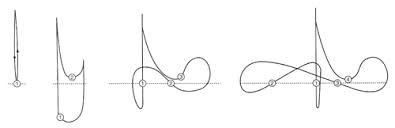
When you are a music major, you take at least one semester of conducting. It is one of the more enjoyable classes because it’s very active. There is not a lot of sitting and listening to lectures. To learn how to conduct, you need to conduct. So it’s a lot of standing and practicing the patterns (yes, there is a method to those movements – see the picture at the top of this page).
What you quickly realize is that just as no two singing voices are the same, no two conducting styles are the same either. You also just as quickly realize that, as in most areas of expertise, some people have an affinity for conducting and others…don’t.
If this is your first time here, or you need a refresher, might I suggest you start with: 3 Leadership Lessons from Great Maestros, How Great Leaders Get Work Done, and 3 Ways to Build a High Performance Team.
We’re exploring lessons to be learned from great music conductors. Today, we are looking at the third lesson to be learned: rigorously crafting, refining, and executing a vision.
Crafting the Vision
Have you ever been around a leader who didn’t have a clear vision? It’s hard to follow that leader because you don’t know where he or she is going. It can make you cautious. It is most certainly frustrating. A leader without a clear vision, is a leader who cannot make decisions. A leader who cannot make decisions, while very common, is nowhere nearly as successful as they could be.
Legend tells us that Ludwig van Beethoven, towards the end of his life, was still composing and conducting though he had lost most of his hearing. In fact, he cut the legs off of his piano so he could lay on the floor and feel the sound vibrations in order to keep composing. At the premiere for his Ninth Symphony, the one featured in the video above, it is said that Beethoven continued to conduct long after the orchestra finished playing. It was only after the concert master stood and touched his arm that Beethoven realized they were no longer playing. He could not hear it, but he had a very clear sound in his mind.
Your vision has to be just as crystal clear.
Refining the Vision
Now…I’m not talking about a pithy statement that you wear on your ID badge and hang on the wall in the break room (although that can be helpful). I mean a real vision of where you need and want your team to be. What are you chasing after? Why does it matter? How will you know if you catch it? When you can clearly answer those types of questions for yourself you are on your way. It is much easier to follow a leader who knows where he or she wants to take you.
I realize that may sound unrealistic. It shouldn’t be. I don’t mean to imply that once the vision is set, you can only go in that one direction. Certainly not. As you move towards the fulfillment of your vision, there may be new opportunities or situations that present themselves that may serve to further refine the original vision into something even better. You absolutely should entertain those ideas and, where it serves the original vision, make adjustments.
Executing the Vision
Once you’ve crafted and communicated a clear vision and started moving your team in that direction, focus becomes critical. Every day there will be distractions that present themselves. Far from being giant time sucks (like endlessly scrolling social media or never ending levels of the latest mobile game) distractions usually disguise themselves as very worthy endeavors. The problem is they aren’t helping you or your team deliver against your vision.
This is perhaps the single most difficult concept for us to grasp in this “postmodern” world. No matter how great or enticing, we simply cannot do it all. We are not meant to do it all. In order to stay true to the vision you have crafted, you have to be willing to say no to what doesn’t advance that vision. That is a very hard thing, indeed. (For more about this topic see this post, The One Skill You Must Master).
Distractions come in all shapes and sizes. Most of them are ultimately good and worthy in their own right. However, as you lead your team, organization, or ensemble, anything that isn’t serving to fulfill the vision is ultimately a distraction. Anything. You have to get rid of it. Cut it off. Shut it down. If you don’t, you’ll soon have your team chasing their tails, not sure how to proceed – or worst of all – afraid to do anything.
This concept is no doubt challenging. I think of it like one of those DIY remodeling shows on cable TV (Fixer Upper, anybody? No? Just me?) On these shows, people find items or sometimes entire properties that are past their prime. They were someone else’s discards. Someone else who didn’t have the vision. Then the right person comes along and with the right guidance creates something extraordinary.
There is certainly someone in the world whose vision of what they are doing is completely different from your vision. What if that person’s vision is actually focused on those same distractions? They will be able to leverage those good and worthy things to fulfill their vision. You will be able to direct your energy to fulfill your own vision. Those good things are still accomplished. You each fulfill what you were meant to fulfill. In the process, the world is changed.
How awesome is that?
A Final Thought
There are a lot of other lessons to be learned. We haven’t touched on the importance of preparation. We didn’t get into the critical nature of rehearsals (meetings) or preparing your team to execute. We only scratched the surface of actual execution. I think, however, I will leave you with this final thought.
Every great performance starts with an idea, a roadmap, and a vision. The conductor, you, has to take that idea (the music), the roadmap (the score), and your vision and invite others into it. Then you have to coach, encourage, teach, empower, and focus those others to execute the vision. When you do it well, in whatever setting, the result is pure magic.
 Look Deeper Solutions
Inspiring and right on, as always. Love reading your blog. Always take something motivational away.
Thanks, my friend. I need to get you to write a guest post!